
Every Texas Hold'em player eventually faces the same moment: you hold a drawing hand, your opponent puts chips in, and you must decide whether to call. Sound poker strategy answers that question with simple arithmetic rather than hope. This guide shows how counting outs, the rule of 2 and 4 and pot odds fit together, so you can judge on the flop or turn whether a call is worth making.
Key Takeaways
- Outs are the unseen cards that complete your drawing hand; a flush draw has 9, an open-ended straight draw 8 and a gutshot 4.
- The rule of 2 and 4 turns outs into a quick equity estimate: multiply by 4 on the flop with two cards to come, or by 2 with one card to come.
- Pot odds equal the amount you must call divided by the total pot after your call.
- A call is profitable over time when your equity is higher than the share of the pot you are paying.
- Implied odds add the chips you expect to win on later streets when your draw completes.
- Good poker strategy weighs maths alongside position, stack sizes and how your opponent plays.
What Are Outs in Poker?
An out is any card left in the deck that turns your hand into what you believe will be the winner. Counting outs is the first step in judging any draw and the foundation of poker strategy for drawing hands. You look at your two hole cards and the board, then ask which unseen cards would complete your hand.
Suppose you hold two hearts and two more hearts appear on the flop. There are 13 hearts in the deck and you can see four, so 9 hearts remain. Those 9 cards are your outs for a flush. The same counting applies to straights, sets and other improving hands.
Discount outs that help you but may also help your opponent. If one of your flush cards also pairs the board and could give a rival a full house, it is a weaker out. Careful poker strategy reduces the count slightly in these spots rather than treating every out as clean.
Counting Outs for Common Drawing Hands
A few draws come up again and again, so it pays to know their outs by heart. Learning these numbers is a core part of practical poker strategy, because it lets you make decisions quickly at the table without stopping to recount every time.
Drawing hand
Outs
Flop to river (approx.)
One card (approx.)
Flush draw
9
35%
19.6%
Open-ended straight draw
8
31.5%
17.4%
Gutshot straight draw
4
16.5%
8.7%
Flush draw plus open-ender
15
54%
32.6%
An open-ended straight draw, such as 8-7 on a 9-6-2 board, can be completed by any of four fives or four tens, giving 8 outs. A gutshot, or inside straight draw, such as 9-8 on a J-7-2 board, needs one specific rank, here a ten, so only 4 outs remain. For poker strategy purposes, combined draws add up fast, which is why a flush draw with an open-ender is often stronger than it first appears.
The Rule of 2 and 4
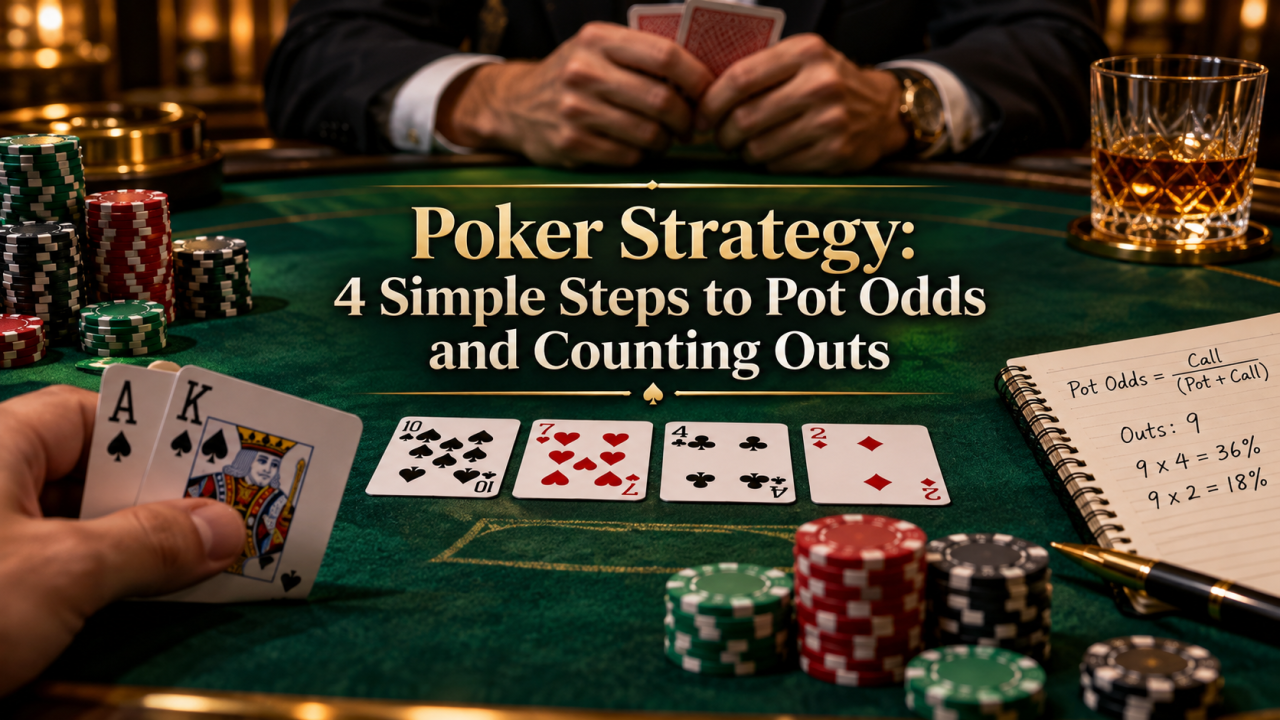
Exact percentages are hard to calculate mid-hand, so most players use the rule of 2 and 4 as a poker strategy shortcut. On the flop, with the turn and river still to come, multiply your outs by 4 to estimate your chance of hitting by the river. On the turn, with one card to come, multiply your outs by 2.
With a flush draw on the flop, 9 outs times 4 gives about 36 per cent, very close to the true figure of roughly 35 per cent. On the turn, 9 outs times 2 gives 18 per cent, against an exact figure of about 19.6 per cent. The rule slightly overstates large draws, so with more than 8 or 9 outs on the flop, some players subtract a little to stay accurate.
One caution: the multiply-by-4 figure assumes you will see both the turn and the river. If your opponent is likely to make another large wager on the turn, you are really only buying one card at a time, so the one-card figure is often the safer number to use.
Pot Odds: The Price of Calling
Pot odds describe the price you are being offered to continue, and no poker strategy for draws works without them. The formula is simple: pot odds equal the call amount divided by the pot plus your call. The result is the minimum equity you need for the call to break even over many repetitions.
Say the pot holds 80 chips and your opponent puts in 20 more, making it 100. You must call 20, and after your call the pot will be 120. Your pot odds are 20 divided by 120, about 16.7 per cent. If your chance of completing the draw is higher than that, calling makes sense in the long run.
Some players prefer to express pot odds as a ratio. In the same example you are calling 20 to win 100, which is 5 to 1. Both forms say the same thing; the percentage version is simply easier to compare directly with the equity numbers from the rule of 2 and 4.
Applying Poker Strategy: Comparing Pot Odds With Equity
The decision rule at the heart of this poker strategy is straightforward. Work out your equity from counting outs, work out your pot odds, then compare. If equity is greater than the pot odds percentage, a call is profitable over time. If it is lower, folding is usually correct unless other factors change the picture.
Take a flush draw on the turn facing a half-pot wager. The pot was 100, your opponent adds 50, and you must call 50 into a final pot of 200. Pot odds are 50 divided by 200, or 25 per cent. Your equity with 9 outs and one card to come is about 19.6 per cent, so on pure maths the call falls short.
Now imagine the same draw facing a smaller wager of 20 into 100. You call 20 to make a pot of 140, so pot odds are about 14.3 per cent. Your 19.6 per cent equity now beats the price comfortably, and calling becomes the stronger choice. The draw did not change; only the price did, which is why poker strategy always starts with the price.
Implied Odds and Reverse Implied Odds
In poker strategy, pot odds only measure chips already in the middle. Implied odds add the chips you expect to win on later streets if you hit. A well-disguised draw against an opponent with a deep stack can justify a call that looks slightly short on immediate pot odds, because you may collect extra chips once the draw completes.
Reverse implied odds work the other way. If completing your draw can still leave you second best, for example a low flush against a higher one, you may lose more on later streets. Strong poker strategy weighs both effects rather than leaning on implied odds to excuse every loose call.
Common Mistakes When Calling Draws
- Counting outs that also improve your opponent, such as a card that pairs the board.
- Using the multiply-by-4 figure when you will likely face another large wager on the turn.
- Ignoring stack sizes, which limit how much implied odds you can realistically collect.
- Calling with weak draws such as gutshots just because they feel close.
- Forgetting that position matters: acting last gives you more information on every street.
Responsible poker strategy also covers your own limits. Treat poker as a game of skill and discipline, not a way to earn a living. Set a bankroll you can afford to lose and a time limit for each session, and stop when you reach either. In Thailand, online card games for stakes are not permitted under Thai law, and the only legal lottery channel is the Government Lottery Office, including its Pao Tang app.
Final Thoughts on Poker Strategy for Draws
Calling a draw stops being guesswork once you follow the same steps each time. Count your outs, convert them with the rule of 2 and 4, calculate pot odds as the call divided by the total pot, and compare the two figures. Then adjust for implied odds, position and your opponent. This simple routine is one of the most useful pieces of poker strategy any Hold'em player can learn.
Disclaimer: This article is for informational purposes only and is not an encouragement to play.